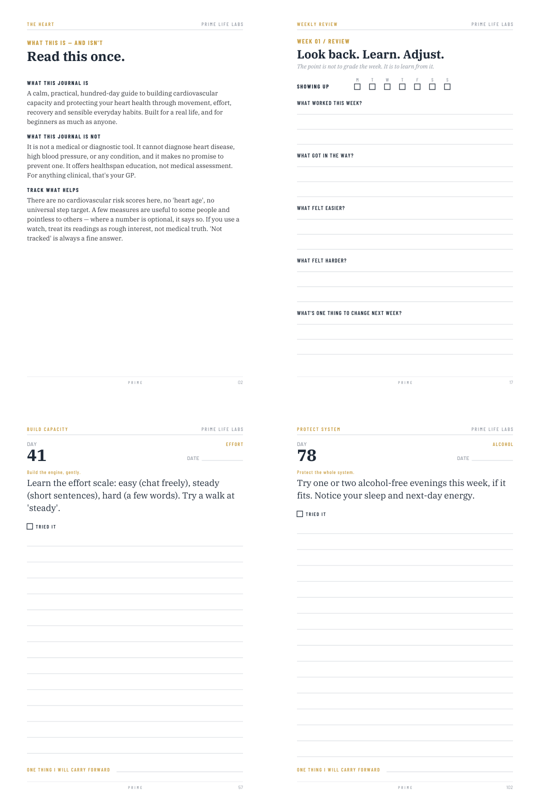
This print-ready PDF journal is designed for men over fifty who want to track, measure and improve their training. Each journal includes:
Daily session log with space for exercises, sets, reps and notes
Weekly review section to reflect on what worked and what didn't
Phased programme that progresses over the full duration
Key metrics tracker for strength, endurance and recovery
Notes section for observations, energy levels and mood
How to Use This Journal
Print the PDF at home or use it digitally. Complete each session log immediately after training — don't rely on memory. Review your weekly progress every seven days and adjust your training based on what the data tells you.
Why Track Your Training?
Men over fifty who track their training consistently make measurably better progress than those who don't. Writing down your sessions creates accountability, reveals patterns, and gives you objective evidence of progress when motivation dips.
Perfect For
This journal works for gym training, home workouts, outdoor training or mixed programmes. Whether you're starting out or returning after a break, the structured format keeps you consistent and focused on what matters.
Strength Training Over 50: The Complete Guide
Strength training over 50 is not optional — it is essential. After 50, you lose 1-2% of muscle mass per year (sarcopenia), bone density declines, and metabolic health deteriorates. The good news: strength training after 50 reverses all of these. This guide covers lifting after 50, from training frequency to the best exercises for men over 50.
How Often Should You Train After 50?
For men over 50, the optimal training frequency is 3-4 sessions per week, each lasting 45-60 minutes. This provides enough stimulus for muscle growth and bone density without overwhelming recovery. If you are new to strength training, start with 2 sessions per week and build gradually. The key is progressive overload — gradually increasing weight, sets, or reps over time. Research shows men over 50 can build significant muscle and strength at any age with consistent training and adequate recovery.
Best Compound Exercises for Men Over 50
Compound exercises work multiple muscle groups at once and deliver the greatest return on investment. For men over 50, the priority exercises are: squats (or goblet squats), deadlifts (or Romanian deadlifts), bench press (or push-ups), rows, overhead press, and carries. These build functional strength for daily life — carrying grandchildren, lifting luggage, moving furniture, and maintaining independence.
Progressive Overload After 50
Progressive overload means gradually increasing the demands on your muscles over time. It does not mean lifting heavier every session. It means tracking your training and making small, consistent improvements. Add 2.5kg when you complete all sets and reps with good form. Add one rep before adding weight. The men who make the best progress after 50 are not the ones who train the hardest — they are the ones who are most consistent with progressive overload. This journal gives you the structure to track and progress every session.
Safety: Training After 50
Training after 50 requires smart programming. Warm up before every session — 5-10 minutes of movement preparation. Prioritise form over weight. Work within your recovery capacity. Listen to your body: if something feels wrong, stop. The Prime approach is calm, evidence-led and sustainable. No ego lifting. No punishing workouts. Just consistent, progressive training built for the long term.
Nutrition for Muscle Growth After 50
Strength training after 50 is only half the equation. You need adequate protein to build and maintain muscle. Aim for 1.6-2.2 grams of protein per kilogram of body weight daily, spread across 3-4 meals. Good protein sources include eggs, chicken, fish, beef, dairy, legumes, and quality protein supplements. Combined with resistance training, this maximises muscle protein synthesis and counteracts anabolic resistance — the reduced ability to build muscle that occurs after 50.
The Prime Approach to Strength After 50
Prime Life Labs was built for men over fifty who want strength, mobility and calm. No crash diets, no six-week miracles, no hype. Just evidence-led, print-ready journals, planners and programmes that work with your body and your life. Start where you are. Track honestly. Progress consistently. That is the Prime standard.
Strength, Mobility and Calm After 50
Prime Life Labs was built for men over fifty who want to train consistently, track honestly and progress steadily. Our approach is evidence-led, print-ready and built for the long term. No crash diets, no six-week miracles, no hype. Just the boring fundamentals done consistently — the way strength is supposed to be built after 50.
What Makes Prime Different
Most programmes are built for 25-year-olds who can recover from anything. You are not 25. Prime Life Labs meets you where you are — with your body, your schedule and your realistic constraints. Our journals, planners, twin packs and coaching are built around evidence, consistency and progressive overload over months and years, not days and weeks.
Start Where You Are
You do not need to be in great shape to start. You just need to be ready to invest in yourself and your future. Take the free PRIME Assessment to get your honest baseline — it takes about 15 minutes. Download a journal or planner to start tracking. We give you the structure; you bring the consistency.
Direct Answer: heart health and cardiovascular after 50
Heart health after 50 depends on three pillars: Zone 2 cardio (3-4 sessions of 30-45 minutes per week at conversational pace), strength training (2-3 sessions per week to improve cholesterol and reduce inflammation), and the Mediterranean diet (vegetables, oily fish, olive oil, nuts, whole grains). These lower blood pressure, improve cholesterol, reduce inflammation and strengthen the heart muscle. After 50, consistency matters far more than intensity — the men who protect their hearts are the ones who train regularly, not the ones who train hardest.
Prime Life Labs is built on evidence-led health practices for men over 50. Every recommendation in this journal is based on cardiovascular research: Zone 2 training, VO2 max, blood pressure, cholesterol management and heart rate variability. We give you the science and a system that protects your heart for the long term.
What To Do Today
Zone 2 cardio: 3-4 sessions of 30-45 minutes per week at conversational pace. This is the foundation of heart health — improves mitochondrial function, lowers blood pressure, improves cholesterol.
Strength training: 2-3 sessions per week. Improves cholesterol markers, reduces inflammation, strengthens the heart muscle.